There are very general spoilers for S4 of The Diplomat in the first paragraph of this blog post. There will be more specific spoilers for the season after the next line break. You have been warned!
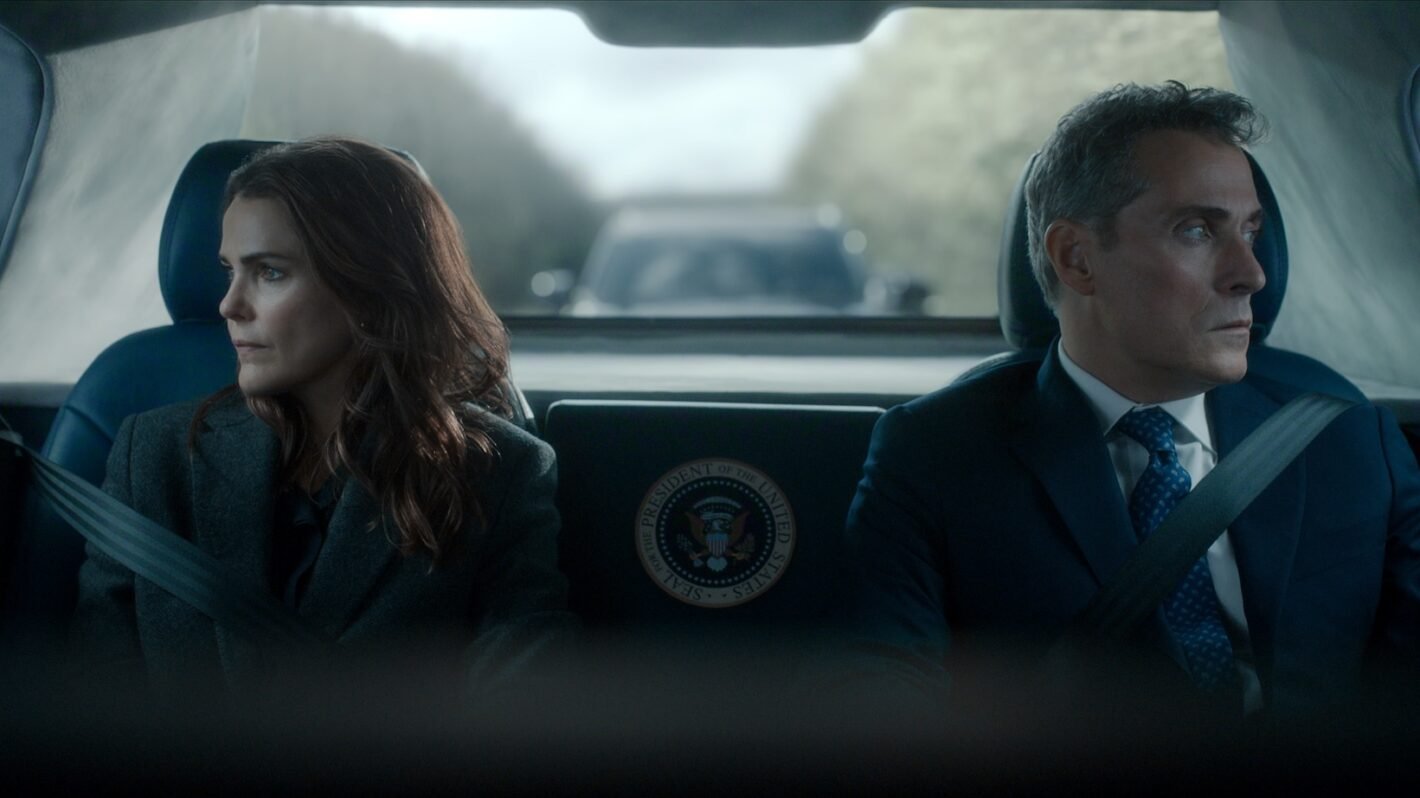
Kate and Hal are not seeing eye to eye
Stop me if you’ve heard this before: a president acting unilaterally against the interests of the country’s allies and the warnings of the president’s own advisors, a vice president who is going along with this recklessness because he is enamored with his new proximity to power even though he had previously spoken out against such abuses of it. Eventually the president threatens to blow up the world order that has been in place since the end of WWII. Such is the endgame of the fourth season of Debora Cahn’s The Diplomat, a show that has never shied away from mirroring the moment it exists within. From depicting a doddering old president who must be saved from himself to the aforesummarized climax of the most recent season of the Netflix show, viewers are asked to draw the parallels between the real world and the fictional.
It’s not a new move for Cahn, who wrote on the back half of The West Wing, the HBO movie Paterno about the disgraced Penn State football coach, and Homeland. Examining these projects makes it clear that Cahn (alongside those she’s surrounded herself with on The Diplomat) excels at building out a plausible “replica with differences” version of the real world and then telling compelling stories within that semi-fictional world that brush up against the stories that are unfolding in real time for the viewers such that the fictional world becomes verisimilar to the real world. The problem, of course, is that the real world is not a tv show written by people whose sense of drama and righteousness has been honed within the mines of Sorkinian serialized storytelling. The ultimate output of this way of making prestige tv is supremely entertaining bullshit, with equal weight placed on both the “supremely entertaining” and “bullshit” parts of that formulation.
Before we get to the ending of the season, where the glorious drama and supreme bullshit politics reach a climax together, some more investigation into those two aspects of the show throughout S4 should give us some grounds for talking about that cliffhanger. Firstly, and perhaps most importantly, The Diplomat is a fantastic drama. It has nicely contained episodes—something not guaranteed in prestige TV of the streaming era—which give it that compelling construction of smaller units of story that each end by propelling viewers to tune into the next episode and which add up to a dramatic larger arc. The first episode, for example, picks up on the drama introduced at the end of the previous season where President Grace Penn (The West Wing’s Allison Janney) and VP Hal Wyler (Rufus Sewell) seem to be developing a close working—and perhaps personal—relationship, a fact that is remarked upon by the First Gentleman, Todd Penn (The West Wing’s Bradley Whitford) and Kate Wyler (Keri Russell), the titular ambassador to England and wife of the VP. The end of the previous season promised that the intersection of the personal and professional realms for these two intertwined couples would dominate S4 and it delivers on that promise.
When Grace is shot at the end of the first episode of the new season, it only amplifies how dangerous it is to mix the personal and professional at these high levels. The remainder of the season is characterized by tense conversations between the four members of this fucked up relational web about diplomatic concerns, interpersonal resentments, and the President’s increasingly irrational and aggressive response to international incidents as well as what she views as personal attacks by her husband. Todd eventually joins Kate across the Atlantic as a “special envoy” to England, a fake job with a fake title that nevertheless puts him at the center of a fraught relationship between supposed allies in the US and the UK. Oh, and just prior to his arrival, Kate had maybe-by-accident-but-also-kinda-on-purpose performed a one-person coup against the Prime Minister in an effort to keep him in line, and the new PM is none to eager to play nice with the US. There’s a lot going on, and Kate has to manage a new coworker who also happens to be married to his (and everyone else’s) boss. Both marriages in this quadruple relationship are at fraught points as the Penn’s try to manage Grace’s unspoken feelings about being shot while the Wyler’s try to deal with Grace’s increasingly tyrannical foreign policy while managing Hal’s newfound proximity to power and his reluctance to make the kinds of moves he once made as a lead ambassador in the Middle East. Every discussion between any of these four characters then carries at least two competing valences as the personal interferes with the political and vice versa. It is compelling drama, and has been at the center of many similar shows, including those previously staffed by Cahn.
Indeed, the personal and political mix more here than they have in the past three seasons combined, where the political took precedence while the personal was more about dalliances that happened on the side that would eventually become entwined with the political machinations only in the climax. There, the personal relationship Kate had with her counterpart in the English government helped them resolve issues that might have become international incidents. In season four, the personal issues the characters have with each other preclude them from making the kinds of political moves that were beneficial and happened with ease before everything went to hell. It is a frustrating season for a show built on the premise that Kate and Hal are master manipulators who could convince their opponents and allies to do the right thing with the perfect argument or, in Hal’s case, the work of his trickster deity wiles. Here every move is blocked by personal resentments or the fear of losing hard-won power. The experience of watching each finely-crafted episode is like observing waves slowly erode the possibility of finishing a sandcastle as you’re building it.
A lot of that frustration comes from the political side of The Diplomat, too, where the show that was once about how a political operative working in the always-complicated Middle East transitions into becoming a VP candidate via the UK ambassadorship has fully become a show about the intractable nature of international politics as run by ego-driven nationalists. Kate is torn up from telling the new Home Secretary that her PM had strangled a British nationalist who organized a false-flag which led to the PM’s resignation because, she is reminded, she practically performed a one-person coup upon her nation’s closest ally. The PM sucked; he was both feckless and evil, but still, the ambassador to the UK should probably not effectively depose him even if he was one of many such assholes driving the world further into chaos. What’s worse is that Kate’s boss, the President of the United States of America, has become one of those assholes, too.
The Diplomat is eager to put most of Grace Penn’s sliding into authoritarian dictator tendencies on her getting shot while visiting the UK in the season’s first episode. Countless conversations about how she has gotten harder to move, quicker to judge and dismiss, incapable of admitting she has done wrong happen between those four main characters of the season and several secondary characters. And yet, none of them are capable of impressing upon her that she has in fact changed. The season’s penultimate episode ends in a dinner between the four of them before the official start of the G7 summit in Tuscany. In it, each instance of Kate trying to maneuver around Grace’s incoherent diktats becomes not only a personal betrayal but also an act of near-treason, while Hal tries to placate and gently prod Grace towards, well, grace. And Todd is there too, admitting that he thinks Grace has changed by not going much farther than that. It is a showdown that Kate can’t lose but also could have never won. Grace is too far gone, Hal is too eager to retain the modicum of power he has finally grasped, and Todd is too focused on repairing his relationship with his wife. You get the sense that rational people could have worked through the communication and temperamental issues to solve the political ones at a dinner like this, and probably would have had this been happening in earlier seasons. But now it is too late, the US is the bad guy and we have an attempted assassination to thank for it.
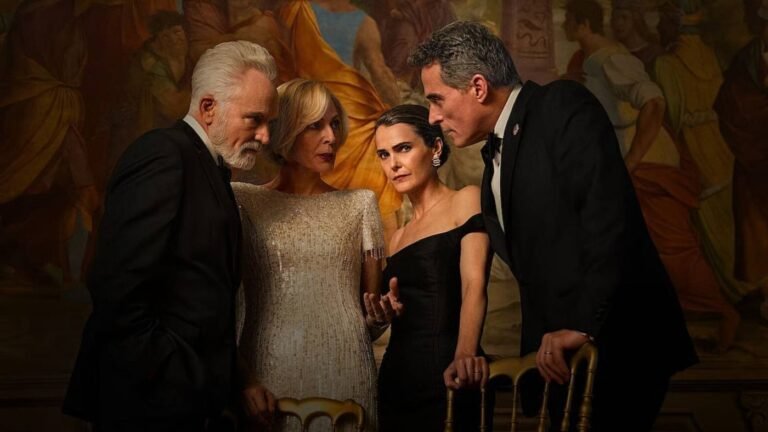
Here they are, the only people who matter
The main problem with the show, the thing that makes it “bullshit,” is the liberal ideology that runs through it which posits that individuals can and do make the biggest differences even in the highest realms of politics. Grace gets shot, becomes a monster, and therefore, in the final episode, all but declares war on the UK (therefore ending NATO). It eschews a systemic explanation for how countries change for one that all but espouses the Great Man theory of history whereby change most frequently occurs because important men (and sometimes women) cause those changes. It is an easy mode to fall into, especially when thinking about something like the Trump administration. It is comforting, in a way, to think that a person’s character flaws and strengths are what guides nations rather than the systemic imbalances and loopholes that have rotted local, national, and international politics around the globe. There are a lot of conversations about guardrails in this season of The Diplomat, but they are largely discussed as one person being a guardrail for another. There is no acknowledgment that something like the Constitution contains guardrails within it that have been ignored or dismantled. It is just the President’s will, and everyone else can either try (and fail) to move her or let her do what she wants to do.
It is easy for viewers to draw the lines between the brutish Presidents Penn and Trump, between Hal Wyler and the weaselly JD Vance. I did it at the start of this blog post in just two sentences. It is easy to map the truncated cause-and-effect relationships that drive popular American storytelling in film and tv to the ways Trump’s elections have upended the post-war political order that have kept things relatively stable for the 60+ years before the last decade of instability. It is therefore just as easy to believe something like what happens at the very end of S4 of The Diplomat could occur and bring all of the chaos and decay to a halt with a simple public display of morality. After Grace declares that she’s going to continue acting unilaterally in the midst of the G7 conference’s attempts at international cooperation the audience sits stunned. The Italian president rambles through prepared remarks about the importance of thinking and acting globally as the other heads of state and audience members murmur amongst each other as they try to reckon with the sudden new world order. It’s all wonderful drama, the contrast between the ineffectual liberal response to the strength of fascist aggression is heightened to its zenith here.
Because of course that is what it takes for a good government functionary to break out of the norms of her position and take a moral stand in front of the whole world, conveniently assembled in one place to both hear Penn’s new doctrine and its rebuttal. After Penn issues her ultimatum to the gathered heads of state, Kate stands, takes off her lanyard that identifies her as a representative of the US government, walks up to Grace at the center of the collected nations, and verbally tenders her resignation, claiming she can no longer serve Grace’s whims. She is followed by Grace’s Chief of Staff, then her Secretary of State, each of whom first removes the lanyard as a symbol of their position within the government before removing themselves from her administration and then the room. The show cuts to the building’s exterior as Grace emerges from the dark shadows concealing the door into the bright light of the Italian morning. The music swells to a climax as the other two join her one at a time, creating line of principled public dissent. But of course we are waiting for Hal, whom Kate had told to disavow knowledge of what was about to happen before she resigned. When Grace turns to him after Kate’s very public rebuke of her administration’s agenda, he claims ignorance and remains seated.
If you thought he too wouldn’t resign, you haven’t been paying enough attention. Hal was always going to defect as well, if only because of Grace’s reprisal against one of Kate’s underlings who had previously published a memo of dissent in the official DOD dissent channel. Kate encouraged her subordinate to publish the memo if only for the historical record, and it’s treated like a joke by both the Chief of Staff and the Secretary of State. The dissent channel is one of those institutional guardrails that have become decayed to the point of uselessness, and the characters treat it as such until it becomes symbolic of the danger Grace poses to the normal way of things. Hal, a lifelong member of the diplomatic corps, recognizes just how far Grace will go to punish those who voice even the mildest, most meaningless dissent based on this act of retribution against a relatively powerless individual in the far reaches of her administration. And so he, too, boldly walks out of the darkness and joins his wife in her righteous stand against authoritarianism. She walks him to the reporters gathered outside the gates of the grounds where the summit is happening and introduces him as the VP who has something important to say. As he says “Good morning,” the show cuts to black for the next howevermany months.
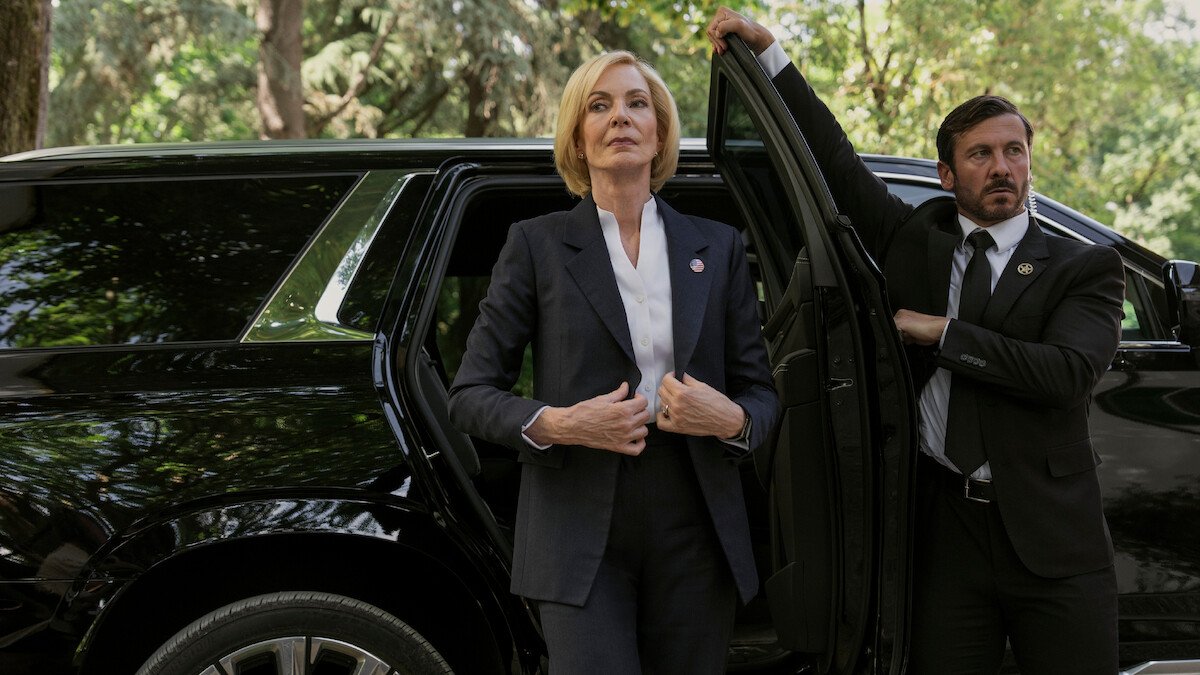
She’s so swishy in her satin and tat
Would that it were so simple. Hal Wyler will not save us. Nor will Keri Russell or Debora Cahn. It seems like every day something as bad as Grace’s takeover of the G7 happens, some act of corruption or brazen disregard for the humanity of the people the Trump administration ostensibly represents occurs and we absorb it. There are almost certainly people within the Trump administration who think it has gone too far in one way or another. But in the real world the kind of retaliation Grace visits upon her underlings does in fact chill a response from within. In the real world the people who could stand up value their meager proximity to power too much to give it up. In the real world our outrage has atrophied following incident after incident that goes unpunished. In the real world one woman (or man) cannot meaningfully stand athwart the ramparts, shouting down the fascists until they stop.
If I were of the conspiracy theorist bent, I might suggest that a show like this is designed to instill the kind of response my mom and I had to the ending moments of the fourth season. “I wish somebody would do that to him.” “It’s so easy!” “Where is our Kate and Hal?” The show’s ideology, I would claim, is the same liberal veneration of the great man that got us into this mess, that made us believe that electing Joe Biden might bring us back to normal rather than postpone a further slide due to his inaction against the perpetrators of fascism at home and abroad. I’m sure Grace Penn won’t be going down without a fight in an eventual season 5, but I’m equally sure that the restored imperfectly perfect Great Diplomat Couple will be there to fight her. They are Good and Grace is Bad and the two of them must meet on the field of ideological battle. Never mind the people. We are but pawns in this ideology, our power diffused until it is seen only in brief glimpses of protestors outside the G7 summit and there contained within designated “free speech zones.” We must wait for Kate and Hal to develop the spine it takes to stand up on your own against immeasurable power. We must wait for the perfect bit of evidence, deployed at the right time by the right people, which—like a shot into a thermal exhaust port—will blow the baddies and their big base into smithereens and everything will be right again.
Luckily, I’m not too much of a conspiracy theorist. I don’t think shows like this turn us into sheep waiting for our masters to tell us where to eat. That’s the same flawed ideology that brings us the political mess that is displayed in the show itself! And yes, while stuff like copaganda and the liberal fantasy of something like The West Wing or The Diplomat are real phenomena, I don’t think these shows are evil. We just shouldn’t be looking to them as anything more than the glorious bullshit they are.
